Showing posts with label HYSA. Show all posts

Thursday, January 4, 2024

Isolation Buckets in the Payment from Savings Banking Model

In order to make the Payment from Savings Banking Model work smoothly, there needs to be some amount of isolation of money within the savings account.  Imagine, for example, if all of the savings money was lumped into one big heap within the same savings account.  It would become very difficult to know:

  • How much money has already been allocated to pay pending bills
  • How much money has been saved for rainy days, major purchases or general savings
  • How much money has been set aside for each child's future
  • How much money is still available to use for "whatever" because it has not yet been allocated for some other use


Separate Savings Accounts

One solution would be to isolated money into different savings account.  That solution would work, but does not seem practical.  Managing a large number of accounts would be cumbersome for several reasons.  For starters, the savings accounts would likely be spread across multiple banks, and it could take several days to move money between accounts should that become necessary.

Separate Virtual Accounts within One Savings Account

A better solution is to have one savings account that allows money to be isolated into separate savings buckets, while continuing to earn HYSA rates for all savings buckets, and allowing easy transfer between savings buckets, and perhaps even easy transfer back and forth between savings buckets and a paired checking account.
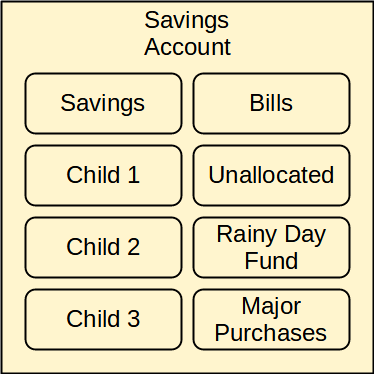


Luckily, some of the banks have started providing technology for using isolation buckets.  The banks typically refer to these as savings vaults, savings goals, virtual accounts (not be confused with virtual credit card numbers), etc..  The banks that provided these features tend to be the "mobile first" oriented banks that work on ease of use from mobile apps before they put the same features into a more traditional web sites.

SoFi HYSA is an Ideal Choice

The SoFi High Yield Savings Account does well at providing all of the desired features.  SoFi calls the isolation buckets "Vaults".  The only difference between the SoFi HYSA and the diagram above is that the bills should probably not be isolated into a vault, but should instead just be the money in the savings account that is not placed into a specific vault, as is indicated by the dotted line below.


With all things being equal, it would make sense to have the unallocated money unvaulted (just floating in the savings account, not isolated into a vault), and put the money for pending bills into a vault.  But, all things are not equal.  Bank ACH transfers to and from the SoFi HYSA will go to and from the unvaulted money.  It is not possible to do bank ACH transfer directly into or out from a vault.  Therefore, since the Payment from Savings Banking Model relies on being able to pay bills directly from the savings account, it makes sense to keep the money for pending bills inside the savings account but outside of a specific vault.  

It should be noted that leaving the bill money unvaulted and making the unallocated money vaulted is not a hinderance, but rather just a practical usage pattern.  The SoFi app and website let you transfer money between checking account, unvaulted savings account, and savings vaults for free, without count or dollar limits, and within seconds.

Revised Payment from Savings Banking Model

Given the discussion above, the diagram of the Payment from Savings Banking Model is now changed as is shown below. 


My next article will go back to the top of that diagram and discuss why the paired checking account still has an essential role in the Payment from Savings Banking Model.


Tuesday, January 2, 2024

Introduction to the Payment from Savings Banking Model

This page introduces the new Payment from Savings Banking Model, which is designed to maximize the amount of money you "make" while paying bills.  Future articles will expand on this new Payment from Savings Banking Model.

Why Is the New Model Viable Now

There used to be US government regulations restricting the number of withdraws you could make from  a "savings deposit" bank account each month or statement period.  But, those restrictions have been removed by the government because of Covid-19.  If you are not familiar with the Traditional Banking Model, or how Covid-19 broke that model because of changes to Regulation D, then you may want to read the following two previously published articles. 
Given the Regulation D wording prior to Covid-19, the Payment from Savings Banking Model was not typically viable;  most households need to pay more than six bills per month.  However, with the Regulation D transfer limits removed, the Payment from Savings Model has become viable.


Simplest Form of the Payment from Savings Banking Model

In it's most simple form, the new Payment from Savings Banking Model moves the bill payments from the checking account to the savings account.

The diagram below shows paying bills out of the checking account.  In this model, the money in the checking account is used to pay bills.  But, that is not the best banking model because the money in the checking account makes little or no interest.


The diagram below shows paying bills of the savings account.  In this model, the money in the savings account is used to pay bills, and that money earns interest until the money is removed from the savings account.  But, you have to make sure to transfer enough money from the checking account into the savings account to cover the bills.


Alternately, you could deposit the wages directly into the savings account, and transfer everyday spending money from the savings account into the checking account.  However, for reasons I will explain in a future article, depositing the wages into the checking account (diagram above) is preferred over depositing the wages into the savings account (image below).


Making It Work -- Choosing the "Right" Bank

The Payment from Savings Banking Model relies on several factors, including choosing the correct bank. In my opinion, SoFi is an ideal choice of bank to use for the Payment from Savings Banking Model because it supports many of the key features that are needed to make the Payment from Savings Banking Model work smoothly.  These features are discussed below.

High Yield Savings Account

Typical bank account offerings pair a checking account with a savings account.  But, what you really need is to pair a checking account with a high yield savings account, or HYSA.  A high yield savings account typically offers an interest rate many times higher that a regular savings account.  For example, at the time of writing this article, traditional savings accounts paired with checking accounts at banks and credit unions were paying about 0.01-0.03%. But, on the same day, the SoFi High Yield Savings account that gets paired with their checking account offering was paying 4.6%.  

If you choose to pay bills from a bank account that is not an HYSA, there is really no point in using the Payment from Savings Banking Model because the earned interest will not be enough for the effort.

Little or No Withdraw Restrictions

There are many banks that offer HYSAs.  They are generally offered as independent accounts instead of being paired with a checking account.  More importantly, however, are the withdraw limits!  Remember that the changes to Schedule D say that a bank can choose to loosen the restrictions if they want to, but does not require the bank to do so.  Many HYSAs have withdraw restrictions similar to the items mentioned below:
  • Hold Times -- Money deposited into the HYSA cannot be withdrawn for a certain number of business days
  • Maximum Withdraw Transactions per Month -- You cannot withdraw money more than a certain number of times per month; each bill pay counts as a withdrawal
  • Maximum Withdraw Value per Month without Written Notice -- You cannot withdraw more than a certain dollar value of money per month without providing written notice of your intent to do so
It should be obvious that any HYSA restrictions similar to the bullet points above would make it utterly impractical to use that HYSA for bill payment.

Isolation of Bill Money and Other Money into Separate Buckets

If you are going to use the Payment from Savings Banking Banking Model effectively, you will want to isolate your bill payment money from the rest of the money.  The Traditional Banking Model does not necessarily do that isolation, as the traditional model generally provides only two buckets in which to hold your money: checking money, and savings money.  But, that does not work so well with the Payment from Savings Banking Model, because really the bill payment money should be isolated from the savings money, and you want both to earn as much interest as possible.

The reality is, however, that you will likely also want to isolate your money into many separate buckets intended for many different purposes, while continuing to earn interest on the money in each bucket.  Importantly, you will want to use a bank that makes it quick and easy to transfer money between the isolation buckets, as well as with external accounts you may have at other banks.

Fast Direct Deposits and Transfers with External Banks

The faster your pay checks and direct deposits are deposited into your account, the sooner you start earning interest.  Likewise for money transferred between banks.  Therefore, you want a bank that does such Bank ACH transfers fast.  Bank ACH transfers take one to three business days.  Many banks will hold onto the money for an extra day or two -- pushing all bank ACH transactions out to three days -- so that they can profit from that money for an extra day or two.  From what I have experienced, SoFi Bank consistently has some of the fastest bank ACH transfers.  Direct deposits are not only consistently two days early, but also typically arrive several hours before other banks that offer 2-day early pay.

Why SoFi?

As you can see from the conversation above, choosing the correct bank with the correct accounts is very important.  The SoFi Bank offering is ideal because of many reasons:
  • Checking account gets paired with HYSA
  • HYSA has good interest rates
  • HYSA has no old-school hold/max withdraw restrictions
  • HYSA provides good isolation of money into separate buckets
  • SoFi consistently has some of the fastest direct deposits
  • SoFi consistently has some of the fastest external transfers, both inbound and outbound

Isolation of money into separate buckets will be the topic of my next article.